
Key takeaways
A new GRU-linked covert unit was created to conduct assassinations and sabotage and avoid past exposures.
It combines centralized state overview and direction with decentralized execution of operations.
The structure integrates personnel from multiple security agencies and includes links to private-sector actors.
In March 2025,The Insider uncovered the existence of a newly formed Russian covert operations unit, referred to as “Center 795.” According to the report, this structure represents a significant evolution in how Russian military intelligence (GRU) organizes and conducts clandestine operations abroad. It is designed not only to execute high-risk missions such as assassinations and sabotage, but also to address the systemic weaknesses that led to the exposure of earlier GRU units.
Why was Centre 795 created?
The creation of this new unit is a direct response to the failures of previous Russian covert operations. Earlier GRU-linked structures, most notably Unit 29155 or the 161st Specialist Training Centre, were repeatedly exposed by Western intelligence services and investigative journalists. These exposures revealed patterns of poor operational security, personnel reuse, and traceable institutional links.
In response, the GRU appears to have undertaken a structural redesign. A key guiding principle in its creation was its isolation as the unit was designed to function as a self-contained entity, with limited interaction with other Russian intelligence or military structures. This was meant to reduce the risk of a compromise amidst increasing international scrutiny.
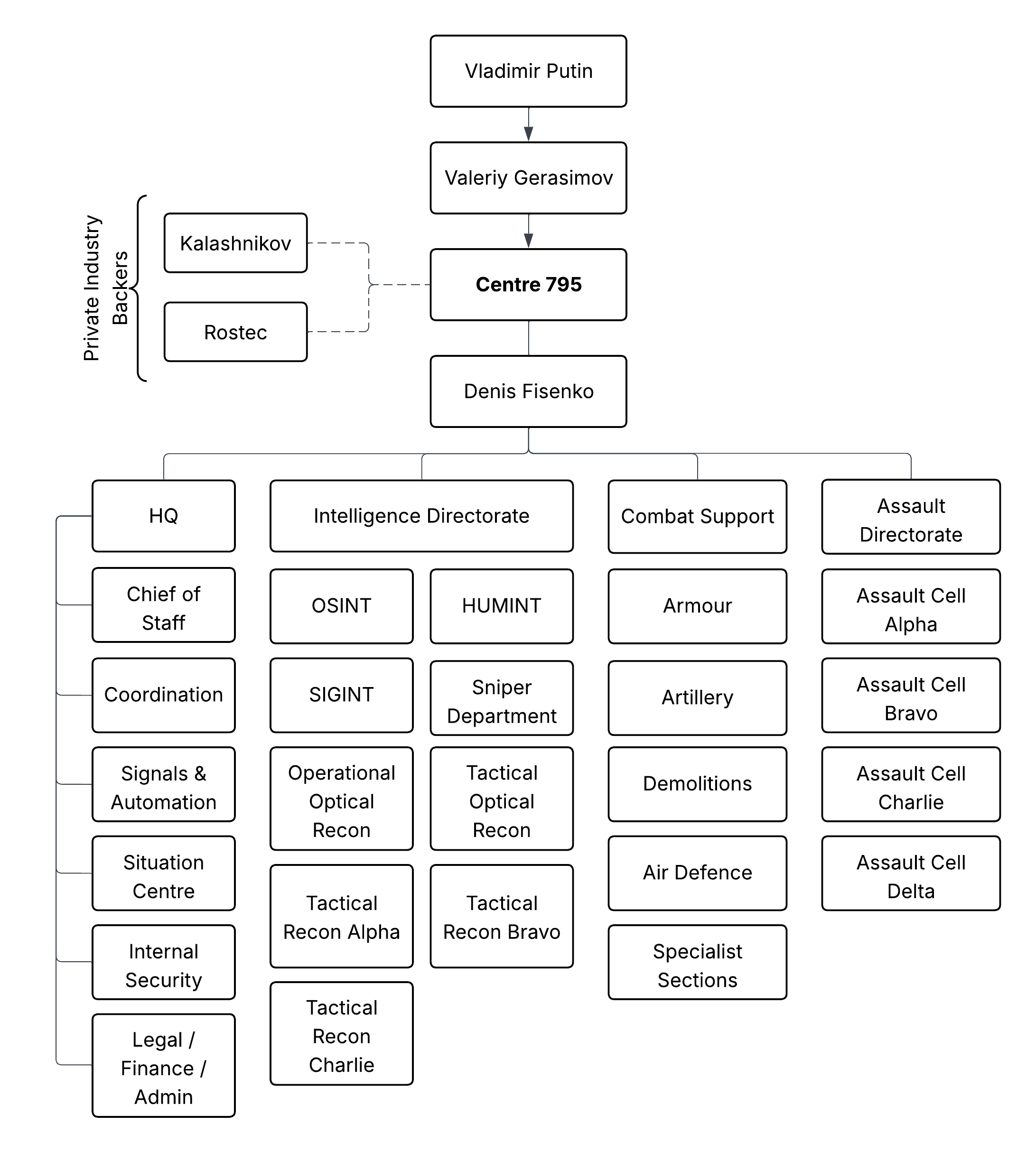
Structure of the Centre 795
With an estimated personnel strength of around 500, it is significantly larger than many traditional covert action groups, and it is organized into multiple directorates, each responsible for different aspects of operations.
Unlike traditional intelligence units, this structure integrates a wide range of capabilities within a single framework. It includes intelligence officers, special forces operatives, technical specialists, and logistical support personnel. This allows the unit to plan and execute operations independently, without relying heavily on external agencies.
Personnel are drawn from elite formations across Russia’s security apparatus, including the GRU, FSB, FSO, and Rosgvardia, as well as from allied services such as the Belarusian KGB. This creates a concentration of expertise that transcends traditional bureaucratic boundaries.
The unit is also designed to be compartmentalized. Internal divisions operate with limited knowledge of each other’s activities to further reduce the risk of exposure.
Figure: Structure of the Centre 795.
Key figures behind the Centre 795
The unit's leadership and operational core comprises experienced intelligence and military figures. At the top is Colonel Denis Fisenko, the unit’s commander, responsible for overall operational direction. Supporting him is Lieutenant General Alexei Iliyushin, a senior figure with prior experience operating under diplomatic cover in Europe and involvement in intelligence and influence activities.
On the operational level, individuals such as Denis Alimov play a critical role. Alimov, in particular, is described as managing a network involved in assassination activities abroad. His arrest became a key factor in exposing aspects of the unit’s operations, highlighting both the system's reach and vulnerabilities.
The Centre is backed by private actors such as Andrey Bokarev and Sergei Chemezov, whose companies provide the necessary financial and technological backing.
Operational model of the Centre 795
Strategic objectives for the unit are defined at the GRU and aligned with broader state priorities. However, the execution of these objectives is decentralized. Operations are carried out through networks of agents, small cells, and intermediaries, often in semi-autonomous fashion.
Rather than relying solely on official personnel, the unit employs extended networks that may include foreign agents, local collaborators, and non-official operatives. This creates additional layers of separation between the state and the act itself, enhancing plausible deniability.
A notable feature of the unit is its integration with private and semi-private actors such as the Kalashnikov Concern. The investigation points to connections with individuals and entities within Russia’s defence-industrial sector, including sanctioned businessmen and companies linked to weapons and drone production.
These private actors contribute in several ways, for example, by (1) providing financial resources outside of formal state budgets; (2) supplying technical capabilities and equipment; (3) providing logistical support that benefits from a non-state cover.