
Kremlin’s men: evolution of Russia’s domestic policy
Key takeaways
Russian domestic policy was shaped by Vladislav Surkov, who initiated the creation of an increasingly authoritarian political system in the mid-2000s.
Vyacheslav Volodin followed in Surkov’s footsteps, making the political system increasingly centralized and repressive, yet also more stagnant.
Today, it is overseen by Sergei Kiriyenko, who has revitalized the system, making it even more centralized and effective while expanding his influence in other areas.
If there were one institution in the Russian Federation that might be seen as the command-and-control nexus for the whole country, it would be the Kremlin, or, to put it in more official terms, the Presidential Administration (PA). The halls and offices of the Kremlin are where key decisions on foreign and domestic policy are made. From invading neighbouring countries, to organizing hybrid warfare against Europe, to shaping and tightly controlling Russia’s own political system and its subjects.
This article will focus specifically on the last aspect of the PA’s activities and discuss the three key figures who helped shape Russian authoritarianism in the 21st century.
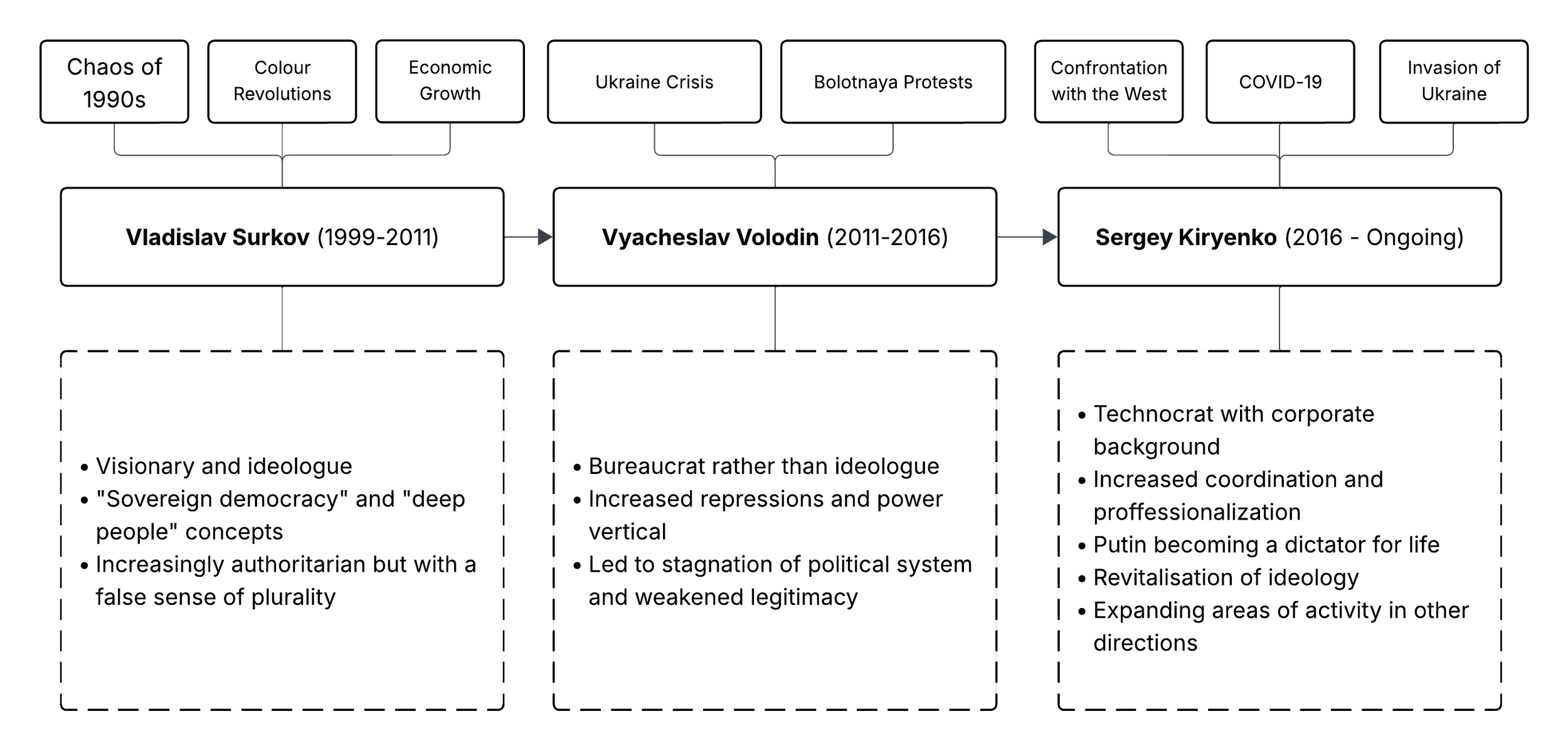
Figure: Key figures in charge of Russia’s domestic policy and their defining factors and characteristics
Vladislav Surkov
Vladislav Surkov is widely believed to be one of the key figures in the creation of the modern Russian political system. During his time as First Deputy Chief of Staff of the Presidential Administration (PA) from 1999 to 2011, Surkov helped create a system in which the PA exercised control over political elites, elections, the media, and even the opposition. Surkov’s era was influenced by internal and external factors such as the chaos and instability of the 1990s and the Colour Revolutions in Russia’s near abroad, which made the shift toward authoritarian governance more appealing to parts of the Russian political establishment and society.
At the same time, much of Surkov’s era coincided with an unprecedented period of economic growth in Russia, which strengthened the appeal of authoritarian rule within parts of Russian society.
In the mid-2000s, Surkov worked relentlessly to promote his idea of a new ideology for Russia, which he described in 2006 as “sovereign democracy.” This concept argued that Russia cannot follow the Western-style democratic model and that it must consider its own, presumably authoritarian, traditions and history while preventing foreign influence in the country. In other words, Surkov argued that political competition in Russia should be managed by the state and therefore the tightening of political freedoms is justifiable.
“Sovereign democracy” quickly became the core idea behind many of Surkov’s projects aimed at promoting Putin’s image and suppressing opposition, such as the widely known “Nashi” youth movement. During his time in the PA, Surkov also promoted the creation of various NGOs and political parties that would mimic plurality in Russian society and politics, while remaining loyal to Vladimir Putin.
In 2019, when Surkov had already left his position in the PA and was serving as an advisor to Putin, he further cemented his role as one of the regime’s key ideologists by introducing another concept, the “deep people” (glubinniy narod). Through this idea, Surkov suggested that the source of the Kremlin’s power lies in a silent and vast majority of Russian society that maintains a passive allegiance to a strong leader.
Vyacheslav Volodin
In 2011, Surkov’s position as the de facto overseer of the PA’s domestic policy bloc was taken over by Vyacheslav Volodin. His era was heavily influenced by the Bolotnaya protests of 2011–2012, the rise of social media and the mobilisation of protest potential, and later by the escalation of the crisis in relations with Ukraine, which led to the annexation of Crimea and the war in Donbas.
These factors effectively accelerated Russia’s shift toward greater authoritarianism and a stronger vertical of power. Under Volodin, it became clear that the façade of political plurality that had existed under Surkov was no longer necessary. Ideological experimentation and the search for a new ideological framework for Putin’s Russia also largely ceased, as Volodin did not present himself as an ideologue or visionary in the way Surkov had. Instead, Volodin’s era focused on stabilizing the regime and establishing a clearer and more disciplined vertical of power.
As a result, the Russian political system became a tightly controlled playground for the elites, and while the system indeed became more stable, it also experienced stagnation, declining citizen participation, and weak political institutions, which, in turn, weakened the regime’s legitimacy.
Sergey Kiryenko
In 2016, Volodin was sent to chair the State Duma, an institution whose influence had been significantly reduced during his time in the PA. Responsibility for Russia’s domestic policy was given to Sergei Kiriyenko, a relatively unknown technocrat from the state nuclear agency Rosatom. Today, Kiriyenko is seen as one of the most powerful power brokers in Russia, and his influence extends far beyond domestic policy.
Kiriyenko’s era has been marked by the escalation and radicalisation of Russia internationally, including confrontation with the West and subsequently Russia’s full-scale invasion of Ukraine in 2022. Domestically, it was marked by the COVID-19 pandemic, which gave the regime greater opportunities for censorship and societal control, and, more importantly, by the constitutional reform of 2020, which effectively allowed Putin to remain in power for life.
Kiriyenko, while continuing in the same direction as Surkov and Volodin, brought new elements from his experience in the corporate world. Under him, Russian elections became more coordinated and centralized, political campaigns more detailed and professional, and performance more systematically measured. Kiriyenko also appears to have revived the search for a new ideology for Russia, a process initiated earlier under Surkov.
Kiriyenko’s influence expanded significantly after Russia’s full-scale invasion of Ukraine. Today, his areas of responsibility can roughly be divided into three key directions.
First, domestic policy and ideology. Following in Surkov’s and Volodin’s footsteps, Kiriyenko is the key figure responsible for organizing Russian elections, managing the political system, and ensuring the regime’s legitimacy. Kiriyenko has also revitalized the search for a new ideological framework for Putin’s Russia. Private entities such as Dialog or the Expert Institute for Social Research are used to develop ideological narratives for Putin’s Russia. Special attention is given to youth policy and the reproduction of the Russian elite through organizations such as Znaniye and the Movement of the First.
Second, influencing and censoring Russia’s internet segment. Kiriyenko oversees propaganda and political messaging within the Russian internet space and major technology companies, while also advancing the concept of a so-called “sovereign internet.” Importantly, Kiriyenko’s son, Vladimir Kiriyenko, serves as the CEO of one of Russia’s largest technology companies, VK.
Third, orchestrating foreign influence operations. Since the full-scale invasion of Ukraine, Kiriyenko has become an increasingly important figure in Russia’s external political influence efforts. He has reportedly overseen operations such as “Maidan-3” and “Doppelgänger,” as well as election-interference campaigns in Abkhazia, Moldova, and Armenia. Furthermore, he may have taken over some of the political influence projects previously associated with Yevgeny Prigozhin in African states such as Mali, Chad, the Central African Republic, and Libya.