
Key institutions behind Russian “sharp power”
Key takeaways:
Russia uses sharp power to disrupt other nations and advance its geopolitical ambitions.
Use of “sharp power” is rooted in the Soviet experience and was revitalized by Vladimir Putin during his second presidential term.
Today, five key institutions of Russian “sharp power” can be identified: Rossotrudnichestvo, Pravfond, the Gorchakov Foundation, the Russkiy Mir Foundation, and the Russian Peace Foundation.
Under the guise of cultural and public diplomacy, they are used to organize and finance covert pro-Russian influence networks and act as fronts for Russian intelligence services.
Introducion
Today’s authoritarian states, most notably China and Russia, are using “sharp power” to project their influence abroad, distorting social and political cohesion in other nations and advancing their wider geopolitical goals. Unlike soft power, which is used by democratic states, sharp power is used as a weapon and always carries a political or geopolitical agenda. At the same time, authoritarian regimes falsely present it as on par with genuine soft power wielded by democracies.
The modern Russian state draws its sharp power traditions from the Soviet era, when the Communist Party established various cultural, peace, youth, women, and friendship organizations to promote its agenda worldwide. These organisations exploited anti-establishment sentiments in the West and promoted left-leaning and anti-colonial ideas globally to counter Western influence.
After the collapse of the Soviet Union, the Russian economy was in shambles. There were barely enough resources to keep the state functioning, let alone to finance extensive networks of sharp-power organisations. Communism was dead, and so were its promotional projects.
This changed during Putin’s second term. By then, the Russian economy had stabilized and even experienced unprecedented growth due to high energy prices; the Second Chechen War was de facto over; domestically, the regime was becoming more repressive, but not to the extent that it would cause major backlash from the general public.
The Kremlin had more time and resources to develop Russia’s foreign policy, which, as it later turned out, proved to be increasingly hostile and imperialistic. This, combined with several popular uprisings in former Soviet republics, such as Georgia (2003), Ukraine (2004), and Kyrgyzstan (2005), led to a decline in Russian influence and promoted the idea that Russia urgently needed to develop foreign influence capabilities.
As a result, several important state-adjacent organisations, sometimes referred to as governmental non-governmental organisations (GONGOs), were established to promote the Russian language and culture abroad. Since their inception, their activities have been heavily securitized and have included operating and financing networks of Russian influence agents abroad, as well as, at times, acting as outright fronts for Russian intelligence and security services.
In the beginning, their activities were primarily aimed at the former Soviet republics, where Russia felt it was losing ground. Their key audience was therefore Russian-speaking minorities in these countries, left beyond Russia’s borders but still unwilling to cut ties with their former motherland. As Russia began using force against its neighbours, especially after the annexation of Crimea, these entities were also used to whitewash Russia’s crimes in the West. As of today, their reach has significantly expanded, and they can be found across much of the world, from the quaint alleyways of Paris to the dusty roads of Bamako.
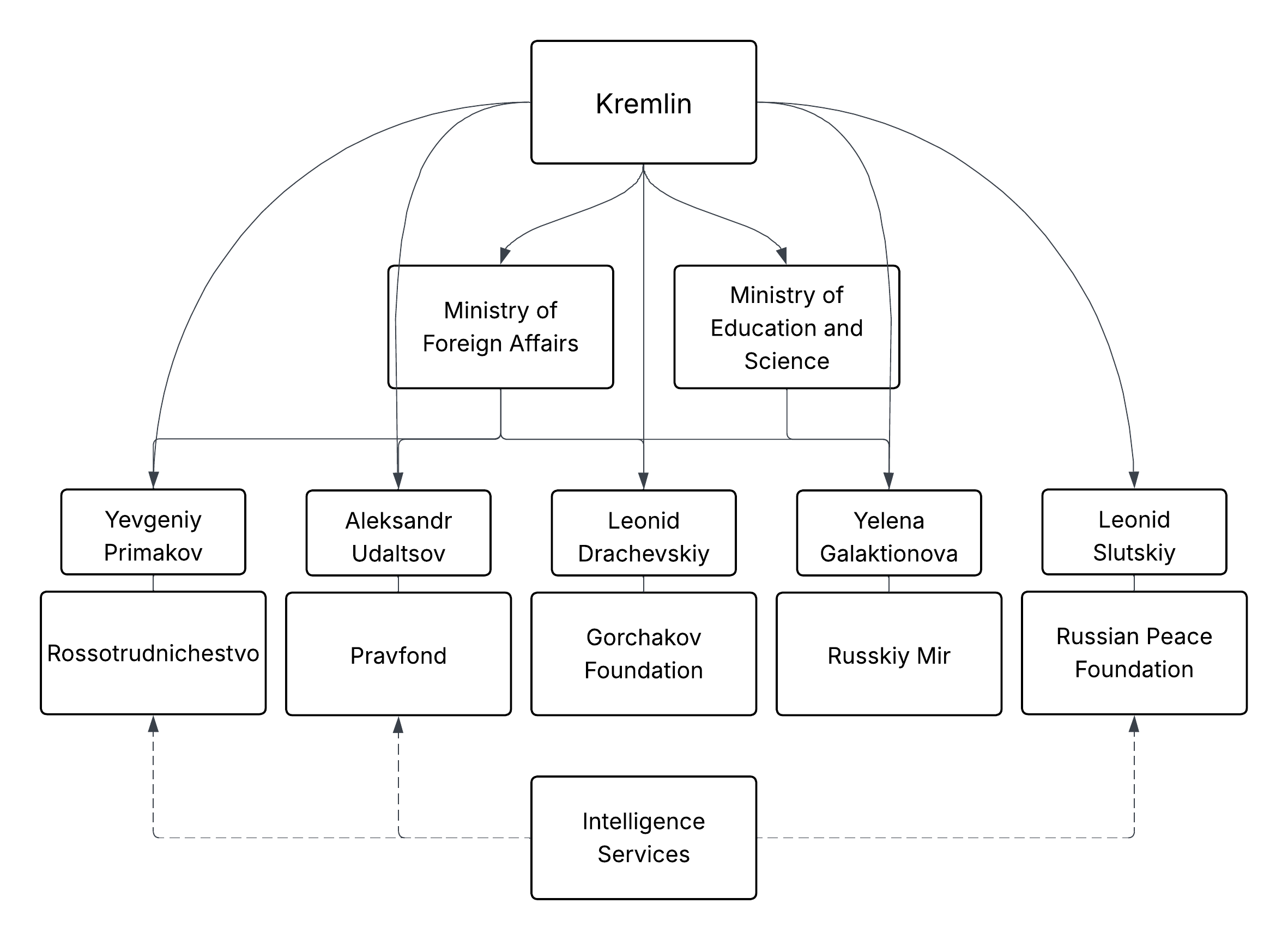
As of today, five key “sharp power” organisations can be distinguished and are addressed in this article: Rossotrudnichestvo, Pravfond, Russkiy Mir, Gorchakov Foundation, and the Russian Peace Foundation.
Figure: Key institutions of Russian “sharp power”.
Rossotrudnichestvo
Rossotrudnichestvo was established in 2008 as a subordinate to both the Ministry of Foreign Affairs (MFA) and the President of the Russian Federation. The agency traces its history to the early days of Soviet rule and to the All-Union Society for Cultural Relations with Foreign Countries, established in 1925. As of today, the agency is Russia’s primary soft power tool abroad, with 87 offices in 71 countries. Since Russia’s war of aggression against Ukraine, it has faced some backlash in Western countries and shifted its attention to the so-called Global South, where, in the last couple of years, more than a dozen new offices, called Russia Houses, have been opened. Despite being Russia’s key soft power organisation, its budget historically has ranged from approximately 45-60 million EUR.
Since 2020, it has been led by Yevgeniy Primakov, the grandson of Primakov senior, former director of the Russian Foreign Intelligence Service and Minister of Foreign Affairs, known for his imperial worldview, criticism of the West, and often regarded as a key figure in shaping modern Russian foreign policy. The agency has close ties to the intelligence services and has been suspected of acting as a front for intelligence officers on numerous occasions.
In 2025, Primakov appointed a new deputy director, Igor Chaika, the son of the once-influential prosecutor general Yurii Chaika, who is known for his ties to the SVR, further cementing the belief that the agency acts in tandem with the intelligence services.
Pravfond
Pravfond was established in 2012 by the MFA and the aforementioned Rossotrudnichestvo to provide legal assistance to Russian compatriots living abroad. Since 2020, it has been led by Aleksandr Udaltsov, a Russian diplomat and former ambassador to Latvia and Lithuania.
Leaked documents have shown that foundations tasks extend far beyond simply providing legal help to compatriots. In reality, it acts as a hub for financing pro-Russian influence agents, organisations, and their operations in at least 48 countries.
Some of Pravfond’s backed activities include paying the legal fees of known Russian agents, such as arms dealer Viktor Bout and FSB contract killer Vadim Krasikov. Lower-level agents are aided by the foundation as well, such as Sergejs Sidorovs, a Latvian taxi driver charged with espionage, or comic figures like the “Aussie Cossack”, a pro-Russian Australian blogger accused of injuring an elderly supporter of Ukraine. While the exact amount of money funnelled through Pravfond remains unknown, it is estimated that, since its inception, the foundation has funnelled “millions of dollars” and awarded more than 1,000 grants.
Similarly to Rossotrudnichestvo, Pravfond is also tightly linked to Russian intelligence services. The same leaked documents have also shown that a number of former SVR officers are employed in leadership positions.
The Gorchakov Foundation
The Gorchakov Foundation was established in 2010 by the MFA and the President of the Russian Federation. The foundation's aim was to serve as a mechanism for promoting Russian public diplomacy through grants, conferences, training programmes, and cooperation with foreign experts, think tanks, and NGOs. It has a rather broad approach, with more than 20 thematic directions and a lack of a very strict focus or mission. The foundation instead works closely with other sharp power institutions, including Rossotrudnichestvo and the Russkiy Mir Foundation, as well as research institutions such as the Russian International Affairs Council and the Russian State Institute of International Affairs.
The Gorchakov Foundation is funded by the state, primarily through the MFA, as well as by donations from “unnamed organisations and citizens”. Some of its programs are also financed through the Presidential Grants Fund. In 2020, the foundation received a 171 million RUB (~1.88 million EUR) subsidy from the MFA.
The Russkiy Mir Foundation
The Russkiy Mir Foundation was established in 2007 by the MFA and the Ministry of Education and Science to promote the Russian language and culture abroad. From its inception until 2020, it was led by Vyacheslav Nikonov, grandson of Vyacheslav Molotov, the former Minister of Foreign Affairs of the Soviet Union. Its activities are mostly concentrated on Russian language education programs, the indoctrination of foreign Russian language teachers, and the financing of academic research on Russian language and culture, as well as other cultural projects.
Nevertheless, first and foremost, it acts as a networking hub for pro-Russian influence agents. It operates the so-called “Russian Centres” and “Russian Cabinets” in at least 40 countries. In addition, it is the organiser of the annual Assembly of the Russian World, one of the main gatherings for pro-Russian influence agents globally.
The foundation is financed by the Russian state; however, the exact amount is unknown. In 2025, it was reported that the foundation would receive approximately 4,5 million EUR from the federal budget for “stimulating interest in the Russian language”.
The Russian Peace Foundation
Lastly, the Russian Peace Foundation is not a GONGO but an NGO that traces its heritage to the Soviet Peace Foundation, established in 1961. The organisation is led by a member of the State Duma, Leonid Slutsky. Along with Slutsky, another key figure in the foundation is social activist Yelena Sutormina. While significantly less influential and less well known than Rossotrudnichestvo or the Russkiy Mir Foundation, it is said to have representatives in at least nine countries abroad.
As with the other institutions discussed, the foundation presents itself on the surface as a non-governmental, independent organisation that promotes Russia’s image abroad. In reality, however, it maintains close ties to the Russian state, with influential figures such as Patriarch Kirill serving on its board.
The foundation has also been linked to Russian intelligence services. In particular, it has been accused of providing the personal data of foreign guests attending its events in Russia to Russian military intelligence (GRU). It has also organised tours for Western politicians to visit occupied Crimea and, more recently, arranged a trip to Russia for the Slovak prime minister's advisers.
The foundation has also been linked to the aforementioned arms dealer Viktor Bout. It reportedly paid at least 25 thousand EUR for his legal defence and, after his return to Russia, helped organise art exhibitions featuring works from his personal collection.